How to Solve Five-Letter Word Guessing Games in Fewer Tries
By the CrazyArcade team ·
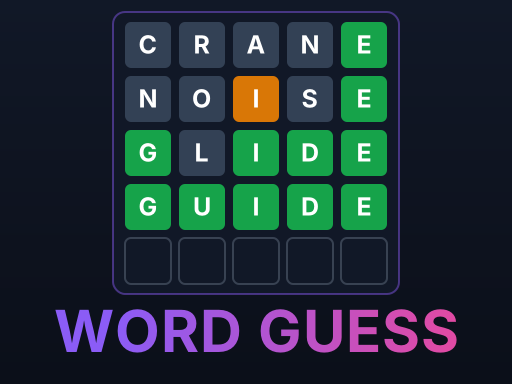
In a five-letter word guessing game, each guess gives you clues: green for the right letter in the right place, amber for a letter that is in the word but somewhere else, and gray for a letter that is not there. Players who solve in three or four tries are not luckier. They choose guesses that collect the most useful clues.
Our own Word Guess game gives you six tries, tracks every letter on the keyboard and offers a Daily Word plus unlimited practice, so you can try these ideas as often as you like.
Start with common letters
Your first guess should test letters that appear in many English words. E, A, R, O, T, L, I, S and N are among the most common. Words such as CRANE, SLATE, ARISE or STARE test several of them at once, without repeating a letter.
Avoid repeated letters in your first two guesses. A word like ERROR tests only three different letters, so you learn less.
Use the second guess to explore
If the first guess gives you little, do not try to use its clues yet. A second guess with five fresh letters, for example following SLATE with CORNY, covers ten common letters in two tries. After that, most words are easy to narrow down.
Read the clues together
An amber letter tells you two things: it is in the word, and it is not in that spot. Move it to a new position in the next guess. A gray letter can be removed completely, and the on-screen keyboard keeps track of them for you.
Remember that words can repeat letters. If you have tried most common letters and are stuck, the answer may contain a double letter, such as in SPOON or APPLE.
Watch for word traps
Some words share four letters with many others, such as _IGHT or _ATCH. Guessing them one by one can use up all six tries. When you have several possible answers that differ in one letter, use a guess that tests as many of those letters as possible at once, even if it cannot be the answer itself.
More word games to try
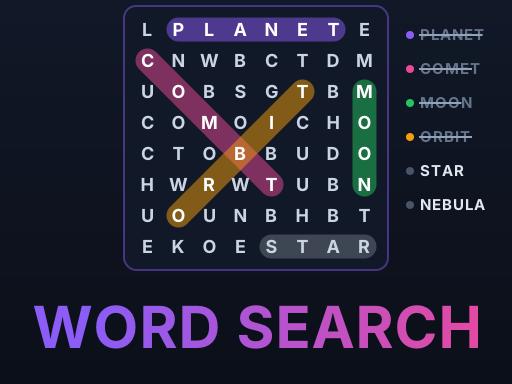
If you prefer a slower pace, our Word Search game hides themed words in a grid, with Easy, Medium and Hard sizes. It is a relaxed way to practise spotting letter patterns.