Mine Sweep Logic: Patterns That Solve Most Boards
By the CrazyArcade team ·
Mine-finding puzzles have a reputation for being about luck. In practice, almost every board can be solved by logic, and the guesses you do have to make are rare. The trick is learning to read a few common number patterns at a glance instead of working out every cell from scratch.
The examples here use our Mine Sweep game. Your first click is always safe and opens an area, numbers show how many mines touch a cell (including diagonals), and you can flag a cell with a right-click, a long press, or the Flag mode button.
The basic rule
Every number tells you how many mines are in the eight cells around it. If a 1 has only one hidden neighbour, that neighbour is a mine. If a 2 already touches two flags, every other hidden neighbour is safe.
Those two ideas, counting the hidden cells and counting the flags, solve a large part of every board. Work around the edge of the opened area and apply them cell by cell before trying anything clever.
The 1-1 pattern
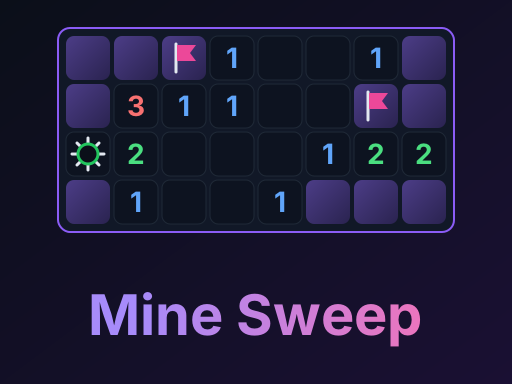
When two 1s sit next to each other along a straight edge of hidden cells, the mine for the first 1 must be in one of the cells they share. That means the cell that only the second 1 can see, the one further along the edge, is safe.
Once you start noticing this, you will see it everywhere along walls and straight borders.
The 1-2 pattern
A 2 next to a 1 along a straight edge works the other way round. The 1 can account for at most one of the 2's mines, so the extra hidden cell that only the 2 touches must be a mine. Flag it, then recount: often the rest of that edge opens up.
Use the mine counter
The counter at the top shows how many mines are left minus the flags you have placed. Near the end of a game it becomes a powerful clue. If one mine is left and only one of two areas can hold it, every cell in the other area is safe.
When you have to guess
Sometimes the numbers really do not decide between two cells, usually in a corner with a 50/50 split. When that happens, guess early rather than late. If you are going to lose, it is better to lose before you have spent several minutes on the rest of the board.
Also prefer guesses that give you the most information if they are safe, such as a cell that would open a new area, rather than one tucked between known numbers.
Practise in the right order
Start on Beginner (9x9 with 10 mines) until the basic rule feels automatic, then move to Intermediate (12x12 with 24 mines) where patterns like 1-2 appear often. Expert (16x16 with 40 mines) is mostly the same skills under more pressure.