How to Solve Nonograms: A Step-by-Step Guide for Beginners
By the CrazyArcade team ·
A nonogram is a picture hidden in a grid. The numbers next to each row and above each column tell you how many filled squares are in that line, and in what groups. Fill the right squares and a small picture appears. Well-made nonograms can be solved by logic alone, one line at a time, without guessing.
This guide uses our own Nonogram game for the examples. Every puzzle in it was checked to have a single solution that line logic can reach.
What the clues mean
A clue of 3 1 on a row means that row has a group of three filled squares, then at least one empty square, then a single filled square, in that order. The groups always appear in the order shown, and there is at least one empty square between two groups. A clue of 0, or no clue, means the whole line is empty.
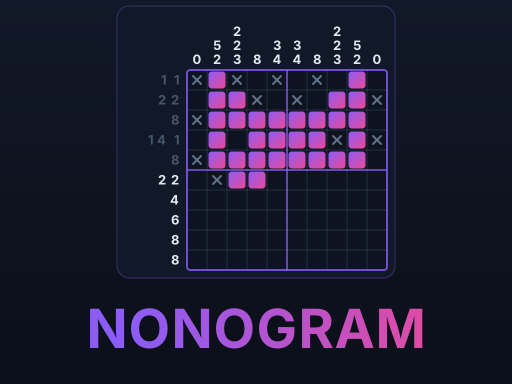
Start with the big numbers
Look for lines where the clues nearly fill the line. On a 10-wide row, a clue of 10 fills the whole row. A clue of 4 5 needs 4 + 1 + 5 = 10 squares, so it also fills the row exactly. These lines are free wins and give you a foothold on the crossing columns.
The overlap trick
For a single large group, imagine pushing it as far left as it can go, then as far right. Any square covered in both positions must be filled. A group of 7 in a row of 10 can start at square 1 or square 4, so squares 4 to 7 are always filled. The rule of thumb: if a group is longer than half the line, its middle squares are certain.
The same idea works with several groups. Push all the groups to the left, then all to the right, and look for squares where the same group covers them both times.
Use crosses for empty squares
Marking squares you know are empty is just as important as filling squares. Once a row's groups are all placed, cross out the rest of the row. Crosses near the edge of a line often limit where a group can go, which lets the overlap trick work again on a shorter stretch.
In our game, right-click or switch to cross mode to mark an X. Crosses do not count against you when the game checks whether the picture is complete.
Work back and forth
Nonograms are solved by alternating between rows and columns. Every square you fill or cross in a row is new information for the column that runs through it. When you get stuck, go through each line again and ask: given the squares I already know, where can each group still fit? Start with 5x5 puzzles to learn the habit, then move to 10x10 and 15x15.