FreeCell Strategy: How to Win Almost Every Deal
By the CrazyArcade team ·
FreeCell is different from most solitaire games because every card is dealt face up. Nothing is hidden, so almost every deal can be solved with careful play. Of the 32,000 classic numbered deals, only one, game #11982, is known to have no solution. If you lose, the deal was almost certainly winnable, and that makes FreeCell one of the best solitaire games for learning to plan ahead.
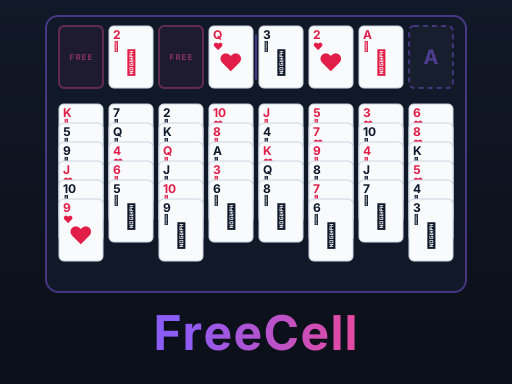
We use our own FreeCell Solitaire for the examples. It uses the classic numbered deals, so you can replay a game by its number, and it has undo, hints and a Restart button that replays the same deal from the start.
Look before the first move
Because you can see every card, take a moment at the start. Find the four Aces and the 2s. Aces buried near the top of a long column are the main problem of the deal, so your first plan should be how to dig them out without filling the free cells.
Treat free cells as a loan
Each free cell holds one card, and every card you put there reduces how many cards you can move at once. With four empty cells and no empty column you can move a run of five cards; with one empty cell, only two. Use a free cell when it leads somewhere, such as freeing an Ace or emptying a column, and try to get the card back out soon.
A common way to lose is filling three or four cells with high cards that have nowhere to go. Before you put a card in a cell, ask where it will go next.
Empty a column early
An empty column is worth more than a free cell. It can hold any card or a whole run, and it doubles the number of cards you can move as a group. Look for a short column with cards that can go to the foundations or onto other columns, and clear it. Once you have an empty column, avoid filling it with a single low card unless that card unlocks several moves.
Build long, ordered runs
Runs of alternating colours in descending order, such as a black 9 on a red 10 on a black Jack, are easy to move later and keep the board tidy. When you have a choice, place a card where it extends a run rather than where it breaks one.
Do not rush cards to the foundations
Moving Aces and 2s up is always safe. Higher cards can be useful in the columns as places to park lower cards of the other colour. In our game, cards on the foundations stay there, so send a card up only when you are sure you no longer need it in the columns.
When you get stuck, use Undo to go back to the last point where you had a choice, or press Restart and try the same deal with a different plan. Replaying a deal you lost is the fastest way to improve.