Dots and Boxes Strategy: Chains, Sacrifices and the Long Chain Rule
By the CrazyArcade team ·
Dots and Boxes looks like a simple pencil game, but it has a surprising amount of strategy. Players take turns drawing a line between two neighbouring dots. Whoever draws the fourth side of a box claims it and must move again. When all the lines are drawn, the player with more boxes wins.
We use our own Dots and Boxes for the examples. You can play on a 3x3, 5x5 or 7x7 board, against the computer or a friend on the same device.
The opening: don't draw the third side
Early in the game, avoid drawing the third side of any box. A box with three sides is a free gift: your opponent takes it and moves again. As long as safe lines are left, players simply avoid this, so the opening is a quiet phase of filling in safe lines.
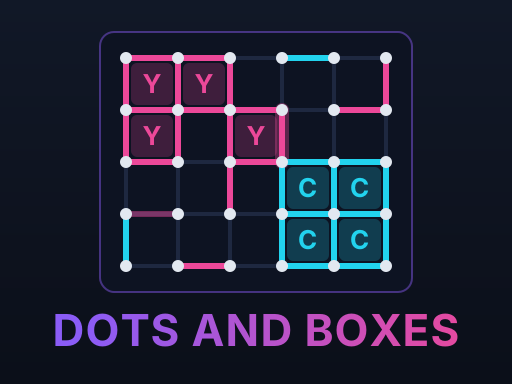
Chains decide the game
Eventually every move gives something away. By then the board has split into chains, rows of boxes where taking one box opens the next, and sometimes loops. The player forced to move first in this phase has to open a chain for the other player.
When you are forced to give boxes away, open the shortest chain first. Giving away a chain of one or two costs little, and you hope your opponent then has to open a longer chain for you.
The double-cross
Here is the key trick. When your opponent opens a long chain, you do not have to take every box. Take all but the last two, then draw the line at the far end so that those two boxes go to your opponent as a pair. They take the two boxes, but then they have to move again and open the next chain for you. Giving up two boxes keeps control of the rest of the game.
On a loop, the same idea costs four boxes instead of two, so loops are less valuable to control.
The long chain rule
Because of the double-cross, the player who controls the endgame is usually the one who can make the opponent open the first long chain, meaning a chain of three or more boxes. Experienced players count the dots and plan the number of long chains so that the count works in their favour. The rule says the first player wants the number of dots plus the number of long chains to be even, and the second player wants it odd. On a 5x5 box board there are 36 dots, so the first player wants an even number of long chains.
This sounds complicated, but you can learn it in steps. Start on the 3x3 board, practise the double-cross against the computer, then move to 5x5, where chains get long enough for the rule to matter.