Checkers Strategy: How Forced Captures Win Games
By the CrazyArcade team ·
Checkers looks simpler than chess, but the rule that captures are mandatory changes everything. You cannot ignore an offered piece, and neither can your opponent. Strong players use that rule to force exchanges that leave them a piece ahead.
The examples use our own Checkers game, which plays by American rules on an 8x8 board: pieces move diagonally forward, captures are compulsory, multiple jumps must be completed and a piece that reaches the far row becomes a king.
Keep your back row for as long as you can
Your back row is the line your opponent needs to reach to make a king. Leaving two or three pieces there for most of the game makes crowning very hard for the other side. Many players keep the pieces on the second and fourth squares of the back row in place until the endgame.
Moving those pieces too early is one of the most common reasons a beginner loses: the opponent slips one piece through, crowns it, and the new king attacks from behind.
Use the forced capture
Because captures are mandatory, you can choose which of your pieces your opponent takes. The classic trick is the two-for-one: you offer a piece, the opponent must jump it, and their jumping piece lands where you can take two pieces back in a double jump.
Before each move, check every capture your opponent will be forced to make next turn and where their piece will land. And check the reverse: before you capture, look at where your piece will end up, because the jump itself can walk into a trap.
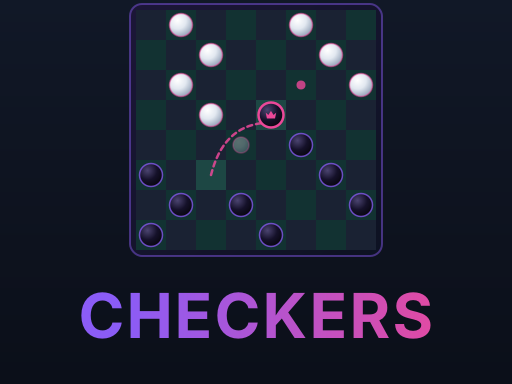
Control the centre and move in groups
Pieces in the middle of the board have more options and are harder to trap than pieces on the edges. Advance in pairs or small groups so each piece is backed by another one. A lone piece far in front of the rest is easy to capture without losing anything in return.
Winning the endgame with kings
Once both sides have kings, being a piece ahead is usually enough, but you have to be patient. Trade pieces when you are ahead, because three kings against two is much easier to win than many pieces against many. Use your kings together to push the enemy king toward an edge, where it has fewer escape squares.
In our version, 40 moves for each side with no capture and no crowning ends the game in a draw, so keep making progress instead of shuffling back and forth.
Practising against the computer
Start on Easy to get used to forced captures, then move to Medium and Hard. The Hard level will rarely give away a piece, so it is the best test of whether your back row and exchange tricks are working. You can also play 2 Players on the same device against a friend.